
John Connelly
ASN:O-351894
Coming soon.
Click here for Video interview with John Connelly, Part 1 Part 2 Part 3 Part 4





Video 1
Video 2
Video 3
Video 4


Personal Thoughts from World War II.
John Connelly—June 7, 1995
Wars are not one of my favorite topics of conversation; and yet my life has been affected by practically every war our country has been involved in. MANY OF YOU SHARE THESE SAME THOUGHTS.
(1) One of my family delved into our ancestry enough to qualify for membership in the D.A.R., so that takes me back to the Revolutionary War period.
(2) My grandfather Kline fought in the Civil War, was taken prisoner, and spent nearly a year in the infamous Cahaba prison. On his release at the end of the war, he was aboard the steamship, Sultana, on his way home, when it blew up on the Mississippi River. Over 1800 lives were lost, but my grandfather was one of only 600 survivors.
(3) An uncle served in World War I.
At the start of World War II, I was a reserve officer, having taken 4 years of R.O.T.C. training while at Purdue. My re-bordered letter came two weeks after Pearl Harbor. On January 1st, 1942 I was in Indianapolis for my Physical Exam. While driving along Senate Avenue, I made a slight driving error, and a police officer told me to “go back to the country where I belonged.” I wanted to tell him I would prefer doing that to where I was going.
I spent 4 years in service, including 2½ years overseas. When we heard the saying “Join the Army and see the World” they must have been talking about me, for I did see much of the world. My travels included three North African countries, Italy, Northern Ireland, England, France, Holland, Belgium, Germany, and Luxemburg. While in England, I saw a small part of Scotland and Wales, and at the end of the war in Europe. I enjoyed seeing some of West Africa, some of South America, British Guyana, and Puerto Rico, before landing in Miami on August 19, 1945.
Except for a 6-week training program at Fort Bragg N.C., all of my service time was spent with the 82nd (All-American) Division. After 4 months of training in Louisiana, the 82nd was divided into two Airborne Divisions, the 82nd and the 101st Airborne Divisions. I then became an officer in the 319th Glider Artillery Bn.
Some friends back home asked Vera why I even volunteered for glider duty -- the answer was simple -- I could choose between glider duty or paratroop duty. So much for preliminaries.
Today, I would like to briefly cover the two major glider landings I was involved in into combat areas – the D-Day landings into Normandy, France, and the Holland invasion in September.
(1) In Normandy, our glider landed about dark on the evening of June 6, 1944. We landed just north of the town of Ste. Mere Eglise. We used a British Horsa glider, much larger than the American CG-4 glider. We carried a Jeep, a trailer loaded with equipment, 6 men, plus a pilot and Co-pilot. Our only problem in landing, the glider crashed into one of the many hedge fences in the area, and the Co-pilot was slightly injured.
Our 82nd Airborne Division fought in Normandy until July 10th, when we returned to England to get ready for our next mission.
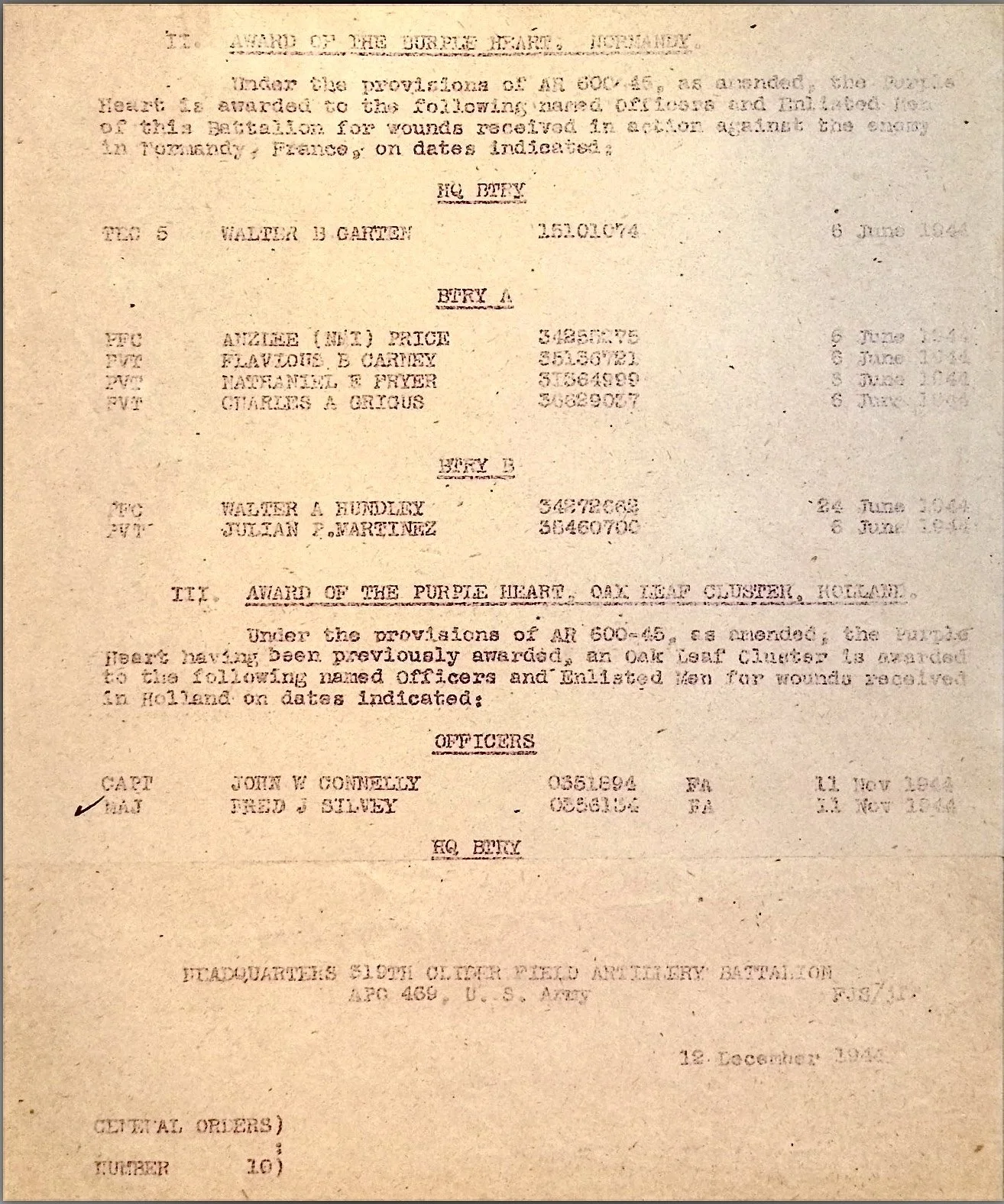
(2) Our second major glider landing occurred on September 18th, 1944, with the invasion of Holland. Seven of our gliders, including mine, landed in a tip of Germany, about 8 to 10 miles beyond where we should have landed. A strong German force was in that immediate area, having target practice, and our slow-moving gliders made an easy target. Our American CG-4 glider included a Jeep, two enlisted men, plus one pilot and myself serving as Co-pilot. Under heavy German fire, our pilot was killed before the glider reached ground, and I had to bring it to the ground, with no previous practice. In getting out of the glider, both the enlisted men were seriously injured, while I had only a minor shrapnel wound. After dressing the wounds, I crawled some distance down a dry ditch and hid under some brush until after dark. After much walking and hiding through the night, I finally contacted friendly troops about 9 A.M. the next morning and was able to reach my own Battalion around 11 A.M. on the 19th. I later learned that I was the only one of 43 men in those 7 gliders who returned safely to our own troops. All others were either killed or taken prisoner. The two injured men from my glider were both taken prisoner, given proper care for their wounds, and were eventually released at the end of the war in Europe.
This information is given only as a prelude to the interesting events occurring during this past year. It was a memorable year for us, primarily as a result of a trip taken by our daughter and son-in-law - - this being a part of the 50th Anniversary of the D-Day landings in Normandy. They spent nearly two years in making plans. They grilled me for many hours about my experiences, where I had been, etc. both while in France and in Holland. Phyllis wrote to the proper authorities in Washington to get special passes for families of veterans who had been there. They made sure their tour group included both the areas in France and Holland where I had been -- so, they were well prepared when starting their 14 day trip.They visited Ste. Mere Eglise, where I had landed, and where much of the 50th Anniversary events took place. They took over 3 hours of video pictures along the way that we enjoyed on their return. They visited the American cemetery, where over 9000 soldiers are buried, including the grave of Lt. Frank Poole, a very close friend of mine. In Ste. Mere Eglise, they saw the dummy hanging from the steeple of the local church -- representing the life of paratrooper John Steel, who parachuted into town and was left hanging there for several hours before being cut down by German troops and taken prisoner. Wherever they went, they proudly wore their 82nd Division All-American patch name tag, with my army picture at the bottom. This promoted many questions from both French and Dutch citizens.
They ended their tour in Holland, where they visited an 82nd Airborne Museum in Groesbeek, Holland. They viewed a panoramic display showing the entire military operation I was involved in. The display even showed the seven gliders location where I had landed beyond our lines. They rented a car and drove out to this area and took more pictures there, in trying to re-live my experiences in evading the German troops there.
The crowning part of the whole story came shortly after their return to their home in Kokomo. They received a letter from the Museum director in Holland, informing them that he knew a former German officer involved in the same operation, and who had written a book recently about his experiences in the same operation. The director gave Phyllis the German officer’s name and address, so Phyllis wrote to him to tell him about my experiences. He replied with a very nice letter, written in English, and sent a copy of his book, written in German. Since then we have had several letters back and forth, and have had his book translated. Our latest letter from Dr. Heinz Bliss received only two weeks ago, stated that he plans to visit the states in late-September, and he will plan to visit with us.
You can see how this past year has been one to remember. It was 51 years ago yesterday when it all started. As I glided over the English Channel, with knots in my stomach, and many questions on my mind, I felt like my world was facing a very rocky future. I prayed that God would allow me to return safely to my family, and He answered my prayers. Many good men, like Lt. Frank Poole, were not so fortunate. Those are the ones who were the real heroes of the war that nobody in their right mind wanted.
In closing, I would say with all sincerity, that it was Faith in God, and the full support of a loving family, that made my war years bearable. When I returned home, my daughter admits that she didn’t remember me. Vera kept the home fires burning by writing V-Mail letters to me every day of the 2½ years I was overseas. There were times I didn’t receive any for several weeks, then I would receive 25 or 30 in one day. She kept me alive in our daughter’s heart, to the extent that now she knows me very well. She also found time to work a full-time job, care for Phyllis, and even found time to send me care packages of cookies, cokes, and other goodies. I consider Vera and Phyllis the real heroes behind my war-time story.
It soon will be 50 years since my return home in late August of 1945. My daughter has long since re-acquainted herself with her Dad, and her trip to France and Holland a year ago has opened new doors as we look ahead to our visit with Dr. Heinz Bliss in September. Where he was once an enemy, we now consider him a good friend.
These are some of the ways a loving God can heal old wounds.
If there are questions, I’ll try to find answers.